The Attic Problem Nobody Points a Thermostat At
Most of the heat working against your air conditioner this summer isn't coming through the walls. It's coming through the roof.
August 27, 2026 · 4 min read
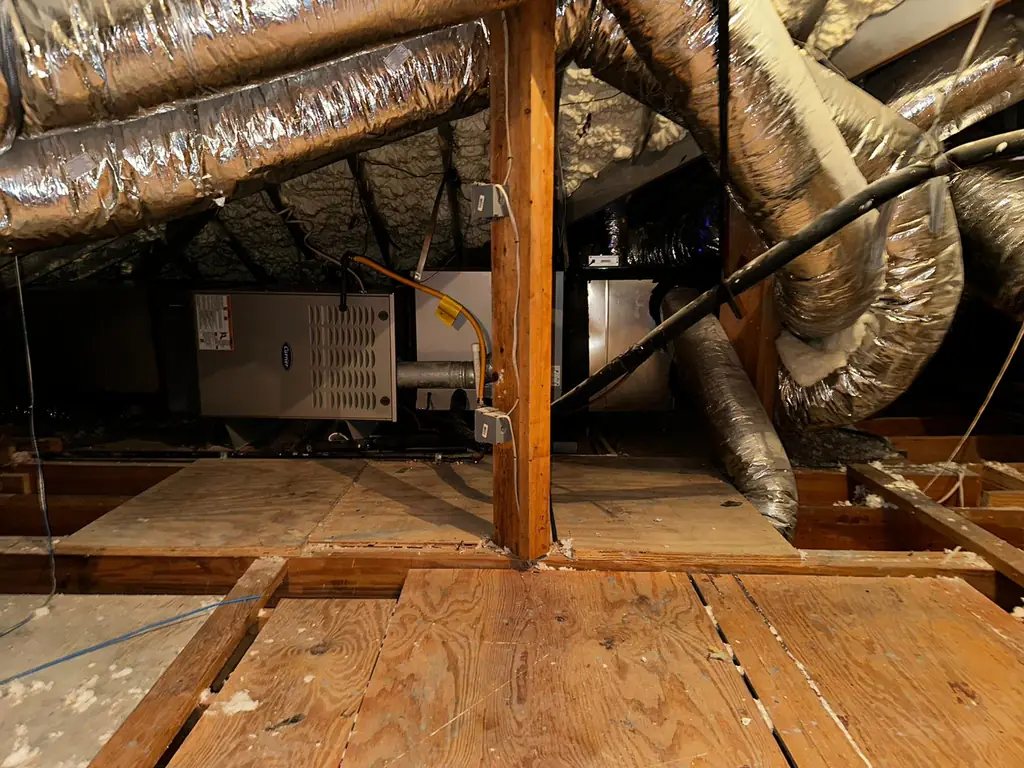
There is a particular kind of July afternoon around Cypress where the air conditioner simply will not stop running. The unit is only a few years old. The condenser is clean, the filter is fresh, nobody can find a refrigerant leak, and it still cannot hold seventy four degrees. Nothing is broken. The unit is doing exactly what it was built to do. The problem is thirty feet above the ceiling, sitting in the dark, doing nothing at all to slow down the sun.
An attic on a July afternoon in this part of Texas can sit well past a hundred and forty degrees under the decking. That heat does not politely stay up there. It moves down through the ceiling drywall into the rooms below by plain conduction, all day and well into the evening, long after the outside air has cooled off and the sun is down. Insulation is the only thing standing between that heat and the living room underneath it. Not the size of the compressor outside. Not the brand on the nameplate. Not how new the ductwork is. If the attic floor is thin, the air conditioner spends its whole runtime fighting a roof deck it can never actually win against.
Insulation does not stop heat from moving. It slows the rate at which it moves, which is a different thing and it is why the worst hours are always the same few in the late afternoon, once the roof deck has spent all day soaking up sun and the attic has had time to fully heat through. A thin layer of insulation lets that heat reach the ceiling drywall quickly. A properly deep layer buys enough time that the sun has usually started to drop before the heat finishes making the trip, which is the entire point of the fifteen-inch standard rather than an arbitrary number someone picked.
What fifteen inches actually means
The Department of Energy's recommended standard for attic insulation is fifteen inches. Across the homes we get into around Cypress and northwest Houston, the average sits at three to five inches, sometimes less where insulation has settled over the years or been kicked around during other attic work. That is not a rounding error. It is the difference between an attic that behaves like an oven and one that behaves like a lid. Based on what we have measured house after house, a home running that thin can lose up to twenty percent of what it spends on heating and cooling in a year, straight through the ceiling, money spent keeping a room comfortable that the attic above it is actively undoing.
It also changes how the rest of the system behaves. A properly sized unit paired with a poorly insulated attic runs longer than it should, cycles harder in the worst part of the afternoon, and takes on wear it would not otherwise see. Swap the condenser for a bigger one and the bill barely moves, because the load driving it was never really about tonnage. It was about how much heat the ceiling was letting through before the air conditioner even got a chance to work on it.
What an inspection actually checks
We do not guess at this from the driveway. A real home energy efficiency inspection means getting into the spaces where the heat is actually moving and measuring what is there, not assuming.
- Insulation depth and coverage across the whole attic floor, not just what is visible at the hatch
- Insulation in exterior walls and crawl spaces, which get skipped far more often than the attic does
- Radiant heat transfer coming down off the roof deck itself
- Attic ventilation, since a poorly vented attic traps heat instead of moving it back out
- Air leaks around can lights, top plates and the places ductwork punches through the ceiling
Insulation and ductwork also share the same attic, which is part of why the two problems tend to compound rather than stay separate. A thin insulation layer means the attic itself runs hotter for longer stretches of the day, and any duct running through that space starts absorbing heat before the cooled air ever reaches a register, on top of whatever it is already losing through the ceiling below. Looking at the ductwork without looking at the insulation, or the other way around, usually only explains part of what is actually driving a high bill.
None of that shows up on a thermostat. A homeowner sees the bill and how often the system runs, not the attic itself, which is exactly why this gets missed for years while a perfectly good unit takes the blame. We have been in thousands of attics around this area over twenty five years, and the same pattern shows up house after house: a system that is working fine, fighting a roof that was never properly finished. Fixing the insulation does not replace the air conditioner. It gives the air conditioner a fair fight, which is usually the actual answer to the question that made someone pick up the phone about their bill in the first place.
Houston Air Comfort, (832) 334-5696
Call (832) 334-5696More articles
What Actually Happens During a Real Maintenance Visit
A five-minute filter check and a signature isn't a maintenance visit. Here's what one actually looks like, and why it matters twice a year here.
Why the Bigger Air Conditioner Is Usually the Wrong One
Bigger sounds like better, but an oversized system cools the air quickly and shuts off before it ever pulls the humidity out with it.