What Actually Happens During a Real Maintenance Visit
A five-minute filter check and a signature isn't a maintenance visit. Here's what one actually looks like, and why it matters twice a year here.
August 27, 2026 · 4 min read
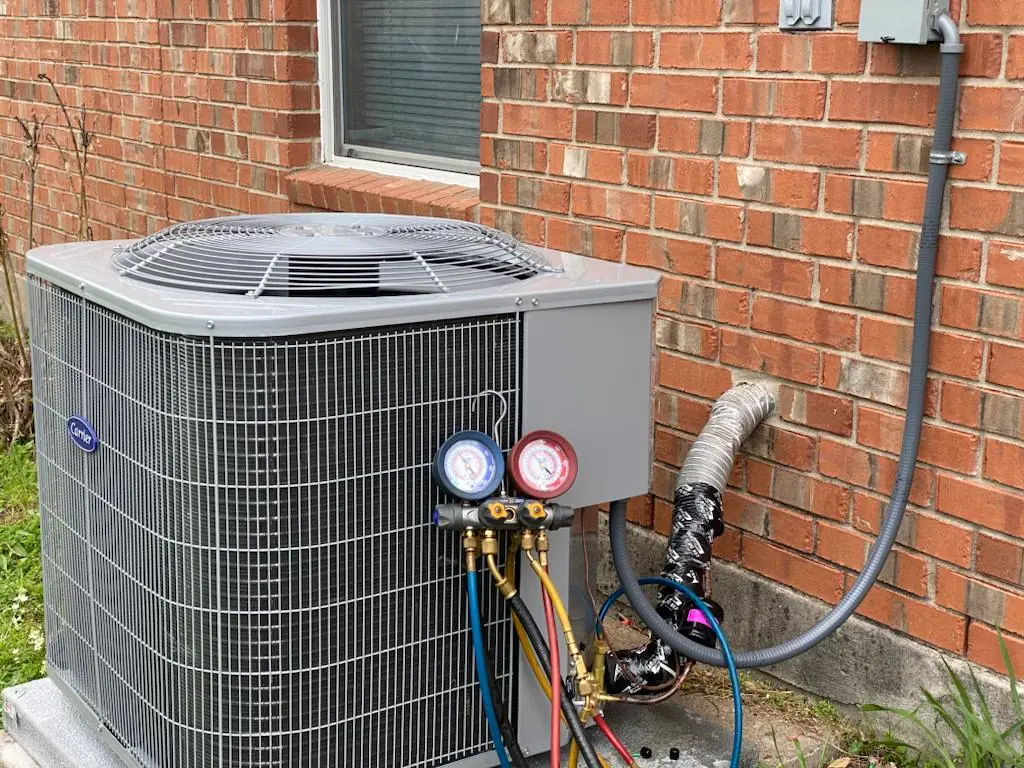
Most homeowners expect a maintenance visit to take about ten minutes. Someone glances at the filter, listens to the unit run for a minute, and leaves a slip on the counter. When it is done properly, it looks nothing like that. A technician connects manifold gauges to the condenser, reads the suction and discharge pressures against what that specific system is supposed to be running at, and only then decides whether the refrigerant charge is actually correct. That single check catches more slow, expensive problems than almost anything else done on a routine visit, because a system running even a little over or under charge is quietly working harder than it should, every single day, without ever throwing an obvious fault.
An undercharged system loses cooling capacity and runs longer to make up for it. An overcharged one can flood the compressor with liquid refrigerant it was never designed to handle, which is one of the more common ways a compressor fails years before it should have. Neither of those shows up by looking at the unit from across the yard. It only shows up on the gauges.
Airflow gets checked the same careful way. A dirty filter does more damage than most homeowners realize, because a system starved for airflow has to work harder to move the same amount of air, and over time that extra strain shows up as a coil that freezes over or a blower motor that fails years earlier than it should have. Checking and swapping a filter is the cheapest, simplest thing anyone can do for a system, and it is also the single most commonly neglected one, because it never feels urgent until the day it very suddenly is.
Why twice a year, not once
The Gulf Coast puts a different kind of load on a system than most of the country deals with. Summer here is not just heat, it is heat carrying an enormous amount of moisture, and pulling that humidity out of the air is a separate job from cooling it. A spring check ahead of the first real heat catches a system that has been sitting idle since the last cool snap, coils that have collected a winter's worth of dust, and a condensate drain that has had months to grow a clog nobody's noticed yet. A fall check catches the other side: a heating system nobody has run in months, about to be asked to work on the one or two nights a year it actually gets cold enough to matter, when a failure is the least convenient kind. Skipping either half of the year does not save the visit, it just moves the surprise to whichever season you skipped.
A proper visit covers both sides of the system, not just the one currently in use. That means the condenser coil gets cleaned rather than just glanced at, electrical connections and the capacitor get tested under load rather than assumed fine because the fan is spinning, the condensate line gets cleared before it backs up into a pan or a ceiling, and the thermostat's calibration gets checked against an actual thermometer rather than trusted on its own display. None of this is dramatic. It is also exactly the kind of thing that, left unchecked for a year or two, turns into the call nobody wants to make in the middle of an August heat wave.
What it actually prevents
A capacitor that tests weak on a spring visit gets replaced on a Tuesday afternoon for the cost of a part and a few minutes of labor. The same capacitor, left alone, tends to fail on the hottest day of the year, at the worst possible time, after the system has already been leaning on it for months. A coil that gets cleaned in March runs at the efficiency it was built for all summer. A coil that never gets cleaned quietly loses capacity the homeowner attributes to the unit getting old, when the unit itself is often fine. The visit is not about finding something wrong every time. Most of the time there is nothing to replace. It is about catching the handful of times a year when there is, before that becomes an emergency call instead of a scheduled one.
A technician who does this properly leaves behind more than a signature on a slip. There should be an actual record of what the pressures read, what the capacitor tested at, and what, if anything, is worth watching next time. That record is what turns a maintenance visit into something useful over years rather than a single isolated check, because it gives the next visit something real to compare against instead of starting from scratch every time someone comes out.
Houston Air Comfort, (832) 334-5696
Call (832) 334-5696More articles
The Attic Problem Nobody Points a Thermostat At
Most of the heat working against your air conditioner this summer isn't coming through the walls. It's coming through the roof.
Why the Bigger Air Conditioner Is Usually the Wrong One
Bigger sounds like better, but an oversized system cools the air quickly and shuts off before it ever pulls the humidity out with it.