What a Property Manager Should Actually Ask About a Rooftop Unit
A rooftop unit sits exposed to the sun, the rain and the wind every single day it's up there. Here's what actually matters when you're responsible for it.
August 27, 2026 · 3 min read
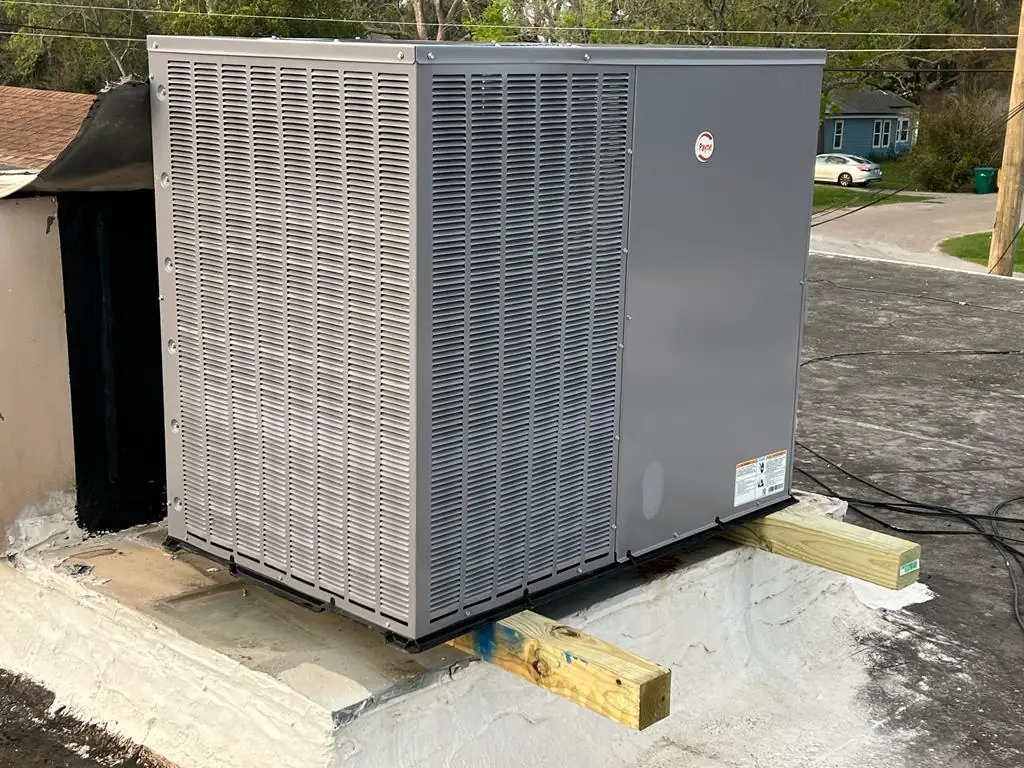
A packaged rooftop unit lives a harder life than almost any residential system. It sits fully exposed on a flat commercial roof, taking direct sun in summer, standing water after a storm, and whatever wind comes off an open parking lot, with none of the shade or shelter a home's condenser gets tucked against a side wall. Anyone responsible for a commercial building, whether that is a retail space, a small office, or a warehouse, ends up making decisions about that equipment eventually. A few of those decisions are worth getting right before there is a problem, not after.
What the equipment itself needs
We handle repair and replacement on packaged units up to twenty five tons, which covers most single-tenant retail and light industrial spaces in this area. On a flat roof, the first thing worth checking is not the unit at all, it is what the unit is sitting on. A rooftop system needs a proper curb or a solid set of support rails keeping it level and off standing water, because a unit that sits even slightly off level puts uneven stress on its own frame and can trap water against the cabinet over time. Drainage around the base matters just as much as the equipment does. A unit that looks fine mechanically can still be sitting in a puddle after every heavy rain because nobody checked how water actually moves across that section of roof.
Beyond the unit itself, commercial work regularly includes duct repair and replacement, thermostat installation and repair, and indoor air quality solutions for spaces where that matters more than it would in a house, a restaurant kitchen or a retail floor with constant foot traffic, for example. None of that is a residential add-on scaled up. It is its own category of work with its own set of things that go wrong.
For a business, a rooftop unit going down is rarely just an equipment problem. A retail floor without air conditioning in a Texas summer sends customers back out the door within minutes. A restaurant kitchen that loses cooling has both a comfort problem for the dining room and a food safety problem in the back, at the same time. A warehouse or light industrial space might tolerate a warmer afternoon better than either of those, but not indefinitely, and not if there is equipment or inventory sensitive to heat. None of that changes what the unit itself needs mechanically, but it does change how much slack there actually is before a maintenance issue becomes a business problem, which is exactly why the response time on a service contract matters as much as the price on it.
Questions worth asking before signing anything
A maintenance contract on a commercial account is only as good as what is actually in it, and most of the value is in the details rather than the headline price.
- Is the estimate for the work itself free, or does the clock start before anyone has looked at the roof
- Is the maintenance plan actually built around this specific business, or is it the same visit schedule applied to every account
- Are the technicians coming onto the property licensed heating and air professionals who have gone through background checks and drug screening
- What happens outside normal office hours if a unit goes down during business hours the next day
- Does the plan cover duct and thermostat issues, or only the rooftop unit itself
Our office hours run Monday through Friday, eight to five, with emergency service available outside that window for the calls that cannot wait until morning. A rooftop unit going down on a Friday afternoon in July is not a problem that keeps until Monday, and a property manager should know before signing anything whether the company on the other end of that contract actually answers on a Saturday, or only says they do.
A custom preventive maintenance plan built around a specific business, rather than a generic schedule applied to every account, is also worth pressing on directly. A retail space that runs its system hard from open to close needs a different visit cadence than a warehouse that is climate controlled for a fraction of the equipment inside it. Asking how the plan was actually built, rather than accepting that a plan exists at all, is usually enough to tell whether the answer is specific to the building or copied from the last account on the list.
Houston Air Comfort, (832) 334-5696
Call (832) 334-5696More articles
The Attic Problem Nobody Points a Thermostat At
Most of the heat working against your air conditioner this summer isn't coming through the walls. It's coming through the roof.
What Actually Happens During a Real Maintenance Visit
A five-minute filter check and a signature isn't a maintenance visit. Here's what one actually looks like, and why it matters twice a year here.